
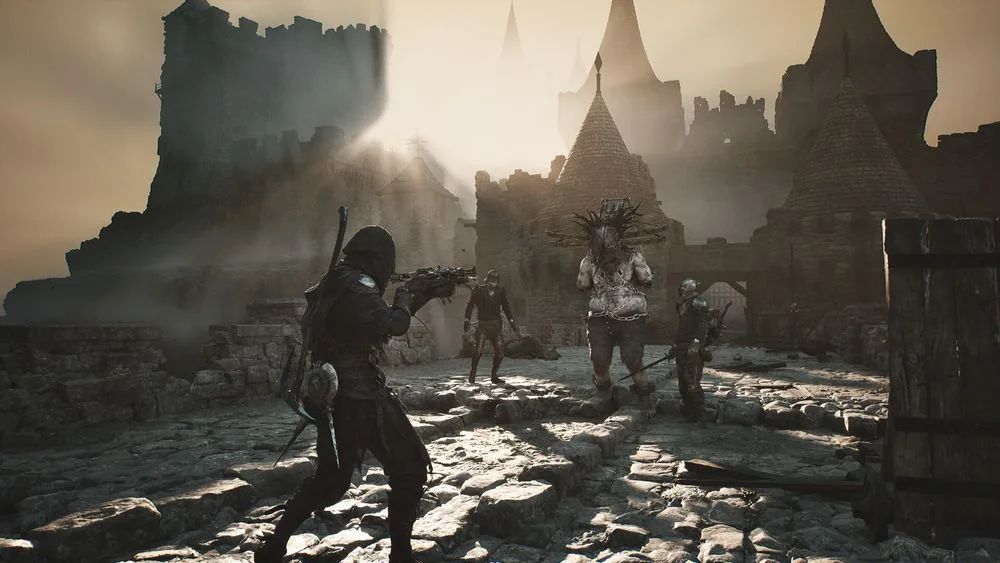
Main weapon tiers
S tier: Axatana. It combines a quick katana mode and a heavier axe mode, so a single slot handles more situations than most alternatives. The switching delay still matters, but Duality Stone and Hexapod Core give it strong follow-through once you understand the timing.
A tier: Axe and Dagger, Black Needle, and Veteran's Battle Axe. Axe and Dagger suits rapid close attacks and Poison setups. Black Needle gives fast thrusts at safer range, while Battle Axe gives a heavy playstyle with more manageable chains than the slowest weapons.
B tier: Clockwork Scythe, Great Martyr's Blade, and Iconoclast. Scythe earns its place through wide crowd-clearing arcs, Great Martyr's Blade through reach and running attacks, and Iconoclast through reliable all-round handling. C tier: Obsidian Hammer, whose damage is high but whose recovery is difficult to fit into fights with repeated unblockable attacks.
Sidearm tiers
S tier: Caged Hystrix and Troubadour's Lute. Hystrix offers rapid fire, chip damage, stagger pressure, and a good answer to enemy groups. The Lute gives confusion and Break damage, which changes the flow of a crowd encounter even though it is less impressive as direct boss damage.
A tier: Forgotten Crossbow, Naylshotte, and Salvaged Trebuchaxe. Crossbow is the obvious general-purpose recommendation because it gives dependable ranged damage when a melee opening is unsafe. Naylshotte is the first sidearm and stays useful as a straightforward option, while Trebuchaxe is another broadly capable ranged tool.
B tier: Ballistazooka and Triarch Repeater. C tier: Cursed Child. These placements are not an instruction to discard them. A sidearm can rise in value when its effect fills a gap in your weapon, Shell, or Tarstone setup.
Why the tiers are not official rules
A tier list measures ease of use and practical damage in a particular set of testing conditions. It cannot measure whether you can safely execute the weapon's attacks against the enemy currently blocking your progress. A weapon that is lower on a general list can be better for a player who already knows its spacing and recovery.
Build access also changes the ranking. Axatana gains a major advantage from Duality Stone, Caged Hystrix benefits from Poison or additional projectiles, and Axe and Dagger benefits from Poison and a crowd-clearing move. Judge a weapon with the stones you actually have, not with a theoretical late-game setup.
The Shell you are using matters too. A mobile or dodge-oriented playstyle may favor quick weapons, while a player who can read parry windows may get more from Battle Axe or Great Martyr's Blade. The tier labels are a starting comparison, not a substitute for the moveset test at a Beacon.
Pick from the list by encounter
For a fast boss with brief openings, start with Axatana, Axe and Dagger, Black Needle, or a ranged sidearm. They let you take a short turn without being locked into a long recovery. Add Poison, Burn, Frost, Phantom, or another available effect when a stone gives the weapon a clear reason to be in the loadout.
For dense encounters, Clockwork Scythe and Troubadour's Lute have obvious jobs. The scythe can sweep a pack, while the Lute can confuse it and create space. Caged Hystrix is another strong group tool because of its rapid shots and ability to stagger enemies before they collapse on you.
For deliberate heavy play, Battle Axe is the best first stop. Great Martyr's Blade works when you can use running attacks, and Obsidian Hammer is for a player comfortable committing to very slow attacks. If a heavy weapon keeps getting interrupted, change the tool or the route rather than trying to force every opening into one oversized swing.
The main-weapon list is most useful when it saves you time. Start with Axatana if you want flexibility, Axe and Dagger or Black Needle if you want speed, and Battle Axe if you want impactful hits without the greatest speed penalty. Iconoclast remains the sensible choice when you have not yet identified a role you need to replace.
The sidearm list is not secondary. A player using a slow blade may get more value from Forgotten Crossbow or Hystrix than from another main weapon. A player crossing a dense route may get more survival from the Lute's confusion than from a small increase in melee damage.
Rankings also change with the amount of practice you bring. A player who cleanly recognizes a Great Martyr's Blade running-heavy opening is using more of that weapon than a player who cancels every attack in panic. The tiers describe broad handling and output, but the repeatable action in the actual encounter is what decides the result.
Use the list as a short route through the collection, not a reason to abandon every lower-tier tool. S and A choices are the easiest places to start testing, while B and C choices ask for a more specific target, move window, or player habit. The resulting loadout should solve your next encounter rather than copy a label. Check each recommendation against your available Tarstones before committing upgrade resources, then revisit the ranking after your preferred weapon has a complete stone pairing and a few difficult encounters behind it.
Related videos
Watch the route and combat use
The first guide starts muted in the lower-right corner on desktop. Choose another video to replace it; close the player at any time.