
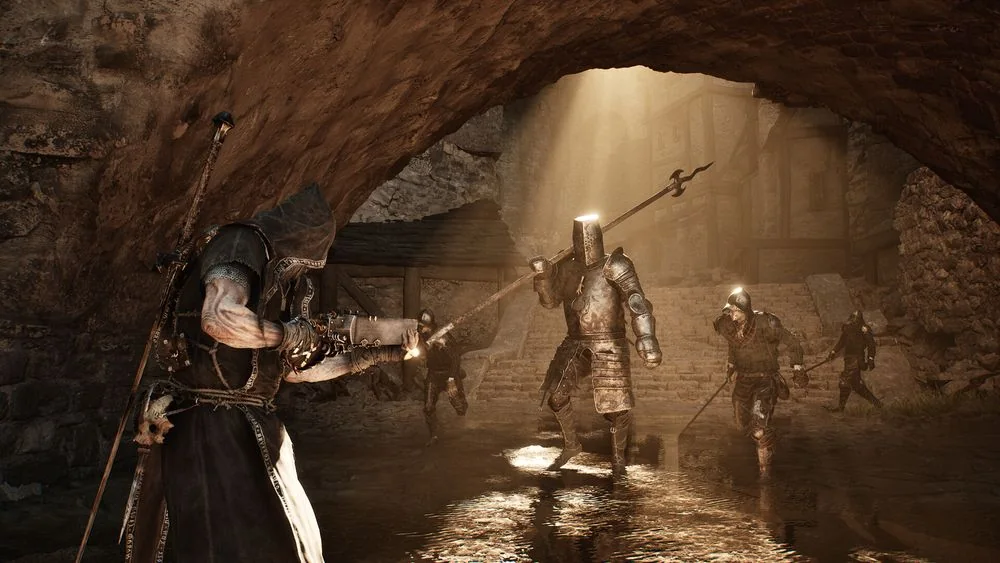
Start with the opening pair
Iconoclast is the opening main weapon, and Naylshotte is the first listed sidearm. Use them long enough to learn how an ordinary weapon and a ranged tool fit together before making a detour for a specialist pickup. Iconoclast remains useful later because it has a balanced moveset rather than a narrow gimmick.
Fainweald contains several early weapon and sidearm routes. The Forgotten Crossbow, Veteran's Battle Axe, Axe and Dagger, Troubadour's Lute, Salvaged Trebuchaxe, and Great Martyr's Blade are all listed there. That density makes Fainweald the natural place to build a first collection instead of waiting for every late-game tool.
Do not assume each pickup is a loose item in the open world. The Axe and Dagger route is associated with Shrine of Trials and a Chapel Key route, while other weapons sit behind dungeon progress or a completed encounter. Mark the last Beacon you used before entering a new side area so a failed attempt does not turn into a long recovery run.
Search Fainweald by route, not by weapon name
The Forgotten Crossbow belongs to the Fainweald collection and works as a reliable ranged option once found. It is especially useful when a target leaves only short melee openings or when you need to apply a sidearm effect from a safer position. Finding it early changes how comfortably you can handle enemies that punish a slow melee recovery.
Veteran's Battle Axe, Axe and Dagger, and Great Martyr's Blade cover very different melee preferences. The Battle Axe offers heavy damage with workable chains, the Axe and Dagger favors quick close attacks, and Great Martyr's Blade has reach and strong running attacks but slow ordinary swings. Pick the detour that matches your combat plan instead of grabbing a heavy weapon simply because it appears first.
Troubadour's Lute and Salvaged Trebuchaxe expand the sidearm collection in the same region. The Lute gives crowd control through confusion and Break damage, while the Trebuchaxe is one of the more generally useful ranged options in this ranking. A sidearm can matter as much as a new main weapon when a route contains dense groups.
Finish the collection in Mammon
Mammon holds Obsidian Hammer, Ballistazooka, Triarch Repeater, Cursed Child, Axatana, Black Needle, Clockwork Scythe, and Caged Hystrix. This gives the later region a large share of both slow heavy weapons and distinctive sidearms. Plan several route stops together rather than returning for one item at a time.
Axatana is in the Ruins of Mammon, inside a hidden part of the Vestige of Infinity. Castigator's Keep Beacon is the stated starting point for that route. A map that marks its overworld position can be bought from Merrick in Marrow Keep for 1,100 Coins, but the route still requires travel through the area and a drop down to the lower zone.
Clockwork Scythe and Caged Hystrix appear together in the Mammon list. The scythe is useful when broad sweeps are more valuable than fast recovery, while Hystrix supplies rapid ranged pressure. Black Needle gives a different answer to the same region's threats because its quick thrusts let you fight from farther out.
Make each detour pay for itself
A location run should have a purpose beyond the pickup. Bring a weapon you already trust, enough healing for a dungeon, and a sidearm that can deal with targets you cannot safely approach. This matters most for slower tools, because a weapon that feels powerful in an empty area can be hard to use in a packed route.
Some Tarstones are tied to the same places and bosses as weapon progress. For example, Duality Stone is listed in Ravaged Tomb east of Nochtean Gate Beacon, and Hexapod Core comes from the Hexapod encounter. When a new weapon has a clear stone pairing, clearing both parts together gives you a real build instead of an untested base item.
If a path becomes too expensive in healing, leave it for a later Beacon cycle rather than forcing a blind completion. The location list establishes which region contains the weapon, not a requirement to collect every item on first arrival. Returning with a different Shell, sidearm, or stone is often the cleaner route.
The first goal in Fainweald is to leave with choices rather than a full inventory. Axe and Dagger gives a quick melee direction, Battle Axe gives a heavier one, and Forgotten Crossbow gives a safer way to answer distant threats. Add Lute when crowd control is the problem, not because a list says every sidearm must be found immediately.
Mammon rewards a more deliberate pass. Axatana, Black Needle, Clockwork Scythe, and Caged Hystrix each fill different combat jobs, and Obsidian Hammer is a high-commitment pickup rather than a simple upgrade. If you find yourself spending all healing on the route to a weapon, come back after opening another Beacon or changing the main weapon you use to travel there.
Location knowledge is also build knowledge. A Tarstone that belongs to a boss or dungeon near a weapon can make that detour more useful than the raw pickup suggests. Plan one route around your target weapon, the stone that reinforces it, and a safe reset point, then leave the rest of the region for a later trip.
Keep the regional order flexible. Fainweald has enough listed tools to form a working set before Mammon, and Mammon then provides specialist alternatives such as Axatana, Black Needle, and Caged Hystrix. A route is successful when you leave with a weapon you can use and enough resources to reach the next Beacon, not when every icon has been cleared in one pass.
Related videos
Watch the route and combat use
The first guide starts muted in the lower-right corner on desktop. Choose another video to replace it; close the player at any time.