
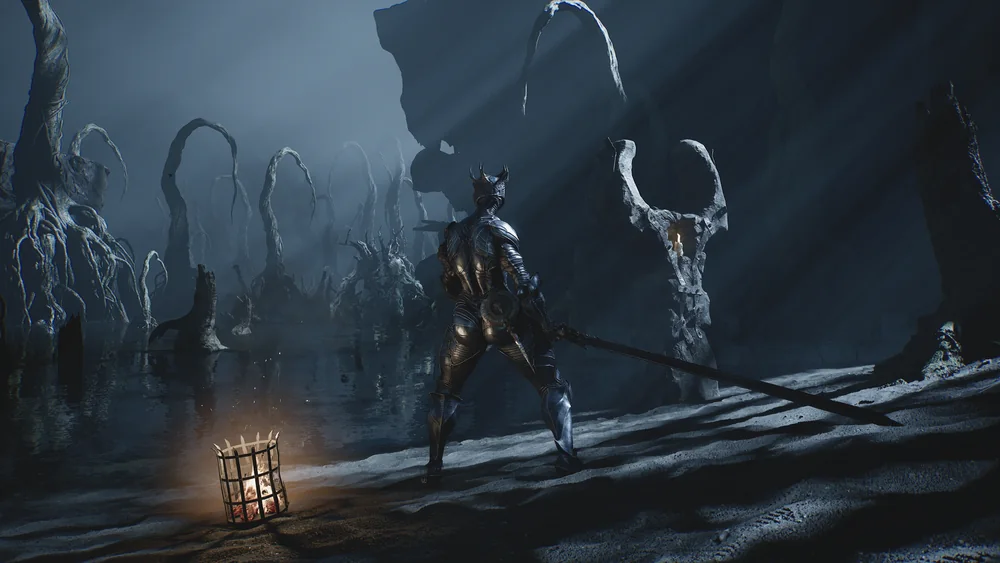
All main weapons
Iconoclast is the starting longsword. It has balanced damage, reach, and handling, so it is the baseline for deciding whether another weapon's advantage is worth its drawback. Shrike Stone can give it a jumping ground slam, while Parasitic Stone can build Leech stacks from kills.
Axe and Dagger, Veteran's Battle Axe, Great Martyr's Blade, and Obsidian Hammer span the close, heavy end of the collection. The paired Axe and Dagger is quick and works well with Poison. Battle Axe has a more manageable heavy chain, Great Martyr's Blade favors running attacks, and Obsidian Hammer is the slowest, highest-commitment option.
Axatana, Black Needle, and Clockwork Scythe complete the main-weapon list. Axatana switches between katana and axe forms. Black Needle is a fast spear that relies on repeated thrusts, while Clockwork Scythe uses broad sweeps to handle groups at the cost of long attack animations.
All sidearms
Naylshotte is the starting sidearm. Forgotten Crossbow, Salvaged Trebuchaxe, Ballistazooka, Triarch Repeater, and Caged Hystrix give the ranged side of the collection several different firing roles. Caged Hystrix stands out for rapid rounds, chip damage, stagger pressure, and crowd control.
Troubadour's Lute is a sidearm with a nonstandard job. It applies confusion and Break damage, so it can turn a dangerous cluster into a more manageable fight even when it is not dealing the highest direct damage. Enfeebling Stone can make targets Fragile, and Hand of Rock adds burst damage.
Cursed Child completes the sidearm roster. It appears in the lower sidearm tier here, while Ballistazooka and Triarch Repeater sit in the middle. That does not make them unusable; it means their value depends more on the encounter and the Tarstones you can support.
Where the collection is spread
The opening gives you Iconoclast and Naylshotte. Fainweald contains Forgotten Crossbow, Veteran's Battle Axe, Axe and Dagger, Troubadour's Lute, Salvaged Trebuchaxe, and Great Martyr's Blade. This gives an early route access to a fast melee weapon, a heavy melee weapon, a crowd-control sidearm, and a general ranged tool.
Mammon contains Obsidian Hammer, Ballistazooka, Triarch Repeater, Cursed Child, Axatana, Black Needle, Clockwork Scythe, and Caged Hystrix. Its pickups favor a later collection pass because the region includes several distinctive specialist tools. Bring a loadout that clears the route first, then swap to the new weapon at a Beacon to test it safely.
Axatana has a particularly specific route. It is in the Ruins of Mammon, in a hidden part of Vestige of Infinity, and Castigator's Keep Beacon is the stated starting point. Merrick sells a map that identifies its overworld position for 1,100 Coins, but the actual path still runs through hostile terrain and a lower drop.
Turn the list into usable loadouts
A complete collection does not mean every weapon needs the same upgrades. Start by keeping one melee weapon whose timing you know, one sidearm for bad matchups, and stones that reinforce their roles. A wide-clearing weapon and a single-target weapon can both be useful, but they should not be expected to solve the same encounter in the same way.
Several named pairings show how much Tarstones matter. Axatana can use Duality Stone and Hexapod Core, Axe and Dagger can use Magdalena's Memento and Serpent Stone, and Battle Axe can use Inflamed Clawstone and Lost Clotstone. These are starting combinations, not a demand to abandon a weapon when a different stone better suits your current Shell.
Use sidearms to cover the gap your main weapon leaves. Pair a slow weapon with ranged pressure, bring the Lute where crowd control matters, or use Hystrix for steady damage and stagger. Testing each new tool at a Beacon after its route is cleared is more useful than ranking it only from its description.
The eight main weapons do not replace one another in a straight line. Iconoclast is balanced, Axe and Dagger is fast, Battle Axe is heavy, Great Martyr's Blade reaches far, Obsidian Hammer commits hardest, Axatana changes form, Black Needle pokes at range, and Clockwork Scythe sweeps groups. A full collection matters because the next route may favor a different job.
The sidearms tell the same story. Naylshotte is the baseline, Crossbow offers general ranged support, Lute controls a crowd, and Hystrix supplies rapid pressure. The other projectile tools can be tested when their handling fits your build, but the listed roles are enough to keep the first loadout decisions clear.
Do not sell a newly found weapon short after one bad arena. Slow tools need long openings, fast tools need close control, and unusual sidearms need the right target. Swap at a Beacon, read the attack strings on ordinary enemies, then decide whether the weapon adds something your established setup lacks.
Keep a simple record of what each pickup changes. Does it let you hit a distant target, break a group, apply a useful effect, or punish a boss after a specific move? If it does none of those jobs better than your current pair, leave it in the collection for now and spend upgrades on the tools you are already using well. That keeps the collection useful instead of turning it into a set of unequipped inventory entries.
Related videos
Watch the route and combat use
The first guide starts muted in the lower-right corner on desktop. Choose another video to replace it; close the player at any time.